.png)



In Traditional Chinese Medicine (TCM), the skin has always been seen as a mirror of internal harmony. Foundational texts such as the Huangdi Neijing (Yellow Emperor’s Classic of Internal Medicine, ca. 200 BCE) describe how the lungs and large intestine govern skin vitality through the movement of Qi, and how emotions like worry or anger can block this flow, manifesting visibly on the skin. Similarly, Ayurveda speaks of doshas (Vata, Pitta, Kapha); when stress disturbs Pitta, inflammation arises, rippling from digestion into the skin. The Sushruta Samhita even outlines seven skin layers—each linked to both mental and physical equilibrium.
在中醫角度,皮膚一直被視為內在和諧的鏡子。經典著作《黃帝內經》(約公元前200年)描述了肺與大腸如何透過氣的運行主宰皮膚的生機,以及憂慮或憤怒等情緒如何阻塞氣的流動,最終顯現在皮膚上。同樣地,阿育吠陀醫學提到三種能量(風、火、水——即Vata、Pitta、Kapha);當壓力擾亂了Pitta時,就會引起炎症,從消化系統蔓延至皮膚。《素問本集》甚至提出皮膚有七層,每一層都與心理和生理平衡相關。
These frameworks anticipated what modern medicine is only beginning to map: the gut, brain, and skin share embryonic origins and remain entwined through nerves, immune signaling, and microbial messengers. Biomedicine began to recognize these links in 1925 with Joseph Klauder’s writings on psychology and skin disease, but it is only in recent decades, through the lens of psychoneuroimmunology, that this axis is being systematically studied.
這些架構早已預示現代醫學才剛開始描繪的事實:腸道、大腦與皮膚有共同的胚胎起源,並透過神經、免疫訊號與微生物傳遞持續緊密聯繫。西醫在1925年由Joseph Klauder有關心理與皮膚疾病的著作中開始注意到這些關聯,但直到近數十年,透過精神、神經、免疫學的角度,這個軸心才被系統性地研究。
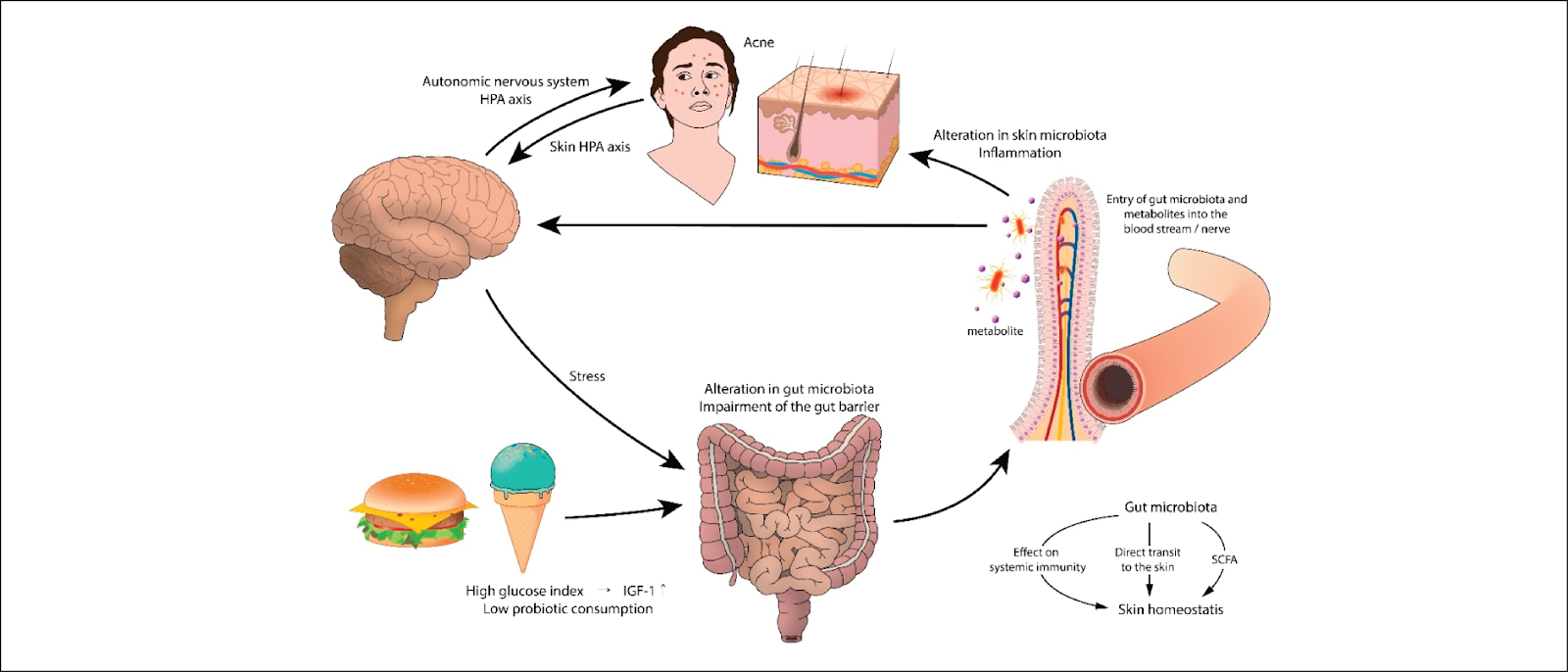
Chronic stress is one of the most powerful disruptors of the axis. Elevated cortisol and adrenaline impair collagen synthesis, increase sebum, and heighten inflammation. The result is often a cycle: stressed minds create skin flare-ups, which in turn amplify stress, driving poor dietary choices that disrupt gut balance.
慢性壓力是此軸心最強大的干擾因素之一。升高的皮質醇和腎上腺素會削弱膠原蛋白的合成、增加皮脂分泌並加劇炎症。結果往往是一個循環:焦慮的心境引發皮膚爆發,而這些問題又會進一步加劇壓力,驅使人作出破壞腸道平衡的不良飲食選擇。
At the same time, a new “skin-brain axis” is emerging. Research in 2025 linked the skin’s microbiome—particularly Cutibacterium—with stress resilience and emotional well-being. This supports what many traditional systems long implied: by tending to the surface, we can nourish the spirit within and vice versa.
同時,一個新的「皮膚與大腦軸」正逐漸浮現。2025年的研究將皮膚微生態,特別是痤瘡丙酸桿菌(Cutibacterium)與抗壓能力及情緒健康聯繫起來。這呼應了許多傳統醫學系統早已提出的觀點:照顧表面,也能滋養內在的精神,反之亦然。
Far from being sidelined, TCM stands at the frontier of this integration.
中醫不僅沒有被邊緣化,反而正站在這種整合的前沿。
Hong Kong plays a leading role. The Chinese University of Hong Kong (CUHK) has studied polysaccharides from Dendrobium officinale and Astragalus membranaceus (2022–2025), finding they regulate microbiota and reduce systemic inflammation linked to diabetes and metabolic syndrome, conditions that ripple into skin vitality. Likewise, Hong Kong Baptist University (HKBU) continues to rank globally for TCM research, with recent publications on compounds such as Alisol B, showing potential in restoring gut balance and lowering liver-driven inflammation, indirectly benefiting skin and mood.
香港在其中扮演領先角色。香港中文大學(CUHK)於2022–2025年間研究鐵皮石斛(Dendrobium officinale)及黃芪(Astragalus membranaceus)的多醣,發現它們能調節菌群並減少與糖尿病和代謝綜合症相關的全身炎症。這些狀況會波及皮膚的活力。同樣地,香港浸會大學(HKBU)在中醫藥研究領域持續位居全球前列,其近期關於藥用成分如澤瀉醇B(Alisol B)的研究顯示,它有潛力恢復腸道平衡、降低肝源性炎症,間接有益於皮膚與情緒。
Even mainstream voices acknowledge this heritage. The South China Morning Post (2019) noted TCM’s recognition of gut-brain links centuries before Western science, calling for integrated models in mental health and dermatology alike.
即使是主流媒體也承認這份傳承。《南華早報》(2019)指出,中醫早在西方科學之前數百年便已認知腸—腦聯繫,並呼籲在精神健康與皮膚科學中建立整合模式。
In clinical practice, psychodermatology recognizes three categories:
在臨床實踐中,心理皮膚醫學將病症分為三大類:
Here, too, TCM and Ayurveda offer not only symptom relief but systemic rebalancing: Qi regulation, dosha pacification, and gut harmonization that address root causes rather than only the surface.
在這方面,中醫與阿育吠陀同樣不僅提供症狀緩解,更注重系統性再平衡:調整氣機、平息能量失衡(dosha)、協調腸道,以處理根本原因,而非僅僅針對表面問題。
The global skincare industry reached ~$165 billion in 2025, with holistic and functional categories growing fastest. Beyond creams and serums, brands are turning toward microbiome supporting probiotics, postbiotics, CBD, and adaptogenic herbs. Rituals now integrate affirmations, aromatherapy, meditation, and even AI-guided personalization.
2025年,全球護膚產業規模已達約1,650億美元,其中整全及功能性品類增長最快。除了面霜與精華,品牌正轉向更注重微生態的益生菌、後生元、CBD,以及適應原草藥。護膚儀式亦逐漸融入正向語句、香薰療法、冥想,甚至人工智能引導的個人化方案。
Yet what sets the next wave apart is essentialism which would be a return to simplicity, science, and cultural integrity. Consumers seek fewer products with deeper impact, and brands that honor traditions like TCM and Ayurveda while grounding their claims in evidence.
然而,下一波的特點在於「本質主義」、回歸簡約、科學與文化完整性。消費者追求的是更少但更具深遠影響的產品,以及能尊重中醫與阿育吠陀等傳統、並以現金科學實證為基礎的品牌。
Psychoneurocutaneous Medicine thus offers more than a clinical framework. It is a cultural bridge—connecting ancient Asian insights with cutting-edge science, and reminding us that the skin we see is always connected to the heart, the gut, and the unseen mind.
因此,精神-神經-皮膚學不僅是一個臨床框架,更是一座文化橋樑,將古老的亞洲智慧與最尖端的科學連結起來,提醒我們眼前所見的肌膚,始終與心靈、腸道及不可見的心志緊密相
Photo Credit :
Unsplash / bencaoquan
Unsplash / @fleuraimeekaan
Unsplash / @kelseyCurtis
Disclaimer: This publishing is made for informational and educational purposes only. It is not intended to be medical and life advice, nor an exhaustive list of specific treatment protocols. The approach and perspective is only based upon the content contributor’s knowledge, research, or clinical experience. The content creators, authors, editors, reviewers, contributors, and publishers cannot be held responsible for the accuracy or continued accuracy of the information or for any consequences in the form of liability, loss, injury, or damage incurred as a result of the use and application of any of the information, either directly or indirectly. Each plan must be individually tailored with the guidance and clinical judgment of your medical or healthcare practitioner or related advisor.
免責聲明:內容僅供資訊及教育用途,並非醫療或專業建議,亦非特定治療方案。本文所提供的方法與觀點,僅基於內容撰稿者的知識、研究或臨床經驗。內容創作者、作者、編輯、審閱者、貢獻者及出版方,對於資訊的準確性或持續準確性,或因使用及應用該等資訊而直接或間接導致的任何責任、損失、傷害或損害,概不承擔任何後果責任。每一項療法或計劃必須在您的醫療或健康護理、或相關專業人員的指導及臨床判斷下,作個別化的調整而定。