.png)





My curiosity about these questions, such as many aspects of life, began very early. Around five or six years old, teachers often complained that I talked during class, but in reality, it was usually classmates sitting beside me who would confide their thoughts to me in the first place.
我對這些問題的感覺,其實來得很早。幼稚園高班時,我已經對生命的許多事情感到好奇。老師常投訴我在課堂上說話,但實際情況往往是不知為何旁邊的同學主動向我傾訴他們的心事。
Once, during Bible class, I heard the story of Jesus Christ suffering for the sins of humanity. I asked the teacher, “If he is a father, why would he allow his own child to bear the pain of others?” To me, it was an innocent question. But the teacher took it as a challenge to her authority. She did not answer and no longer allowed me to ask questions. It was then that I began to understand some questions do not always have a place to be asked.
有一次在聖經課上,我聽到耶穌基督替世人背負罪而受苦的故事。於是我問老師:「如果作為父親,他為甚麼會讓自己的孩子承受別人的痛苦?」對我來說,那只是出於天真的疑問。但老師誤以為我在挑戰她的權威,沒有回答,也不再允許我提問。於是我開始明白,有些問題,不一定有地方可以問。
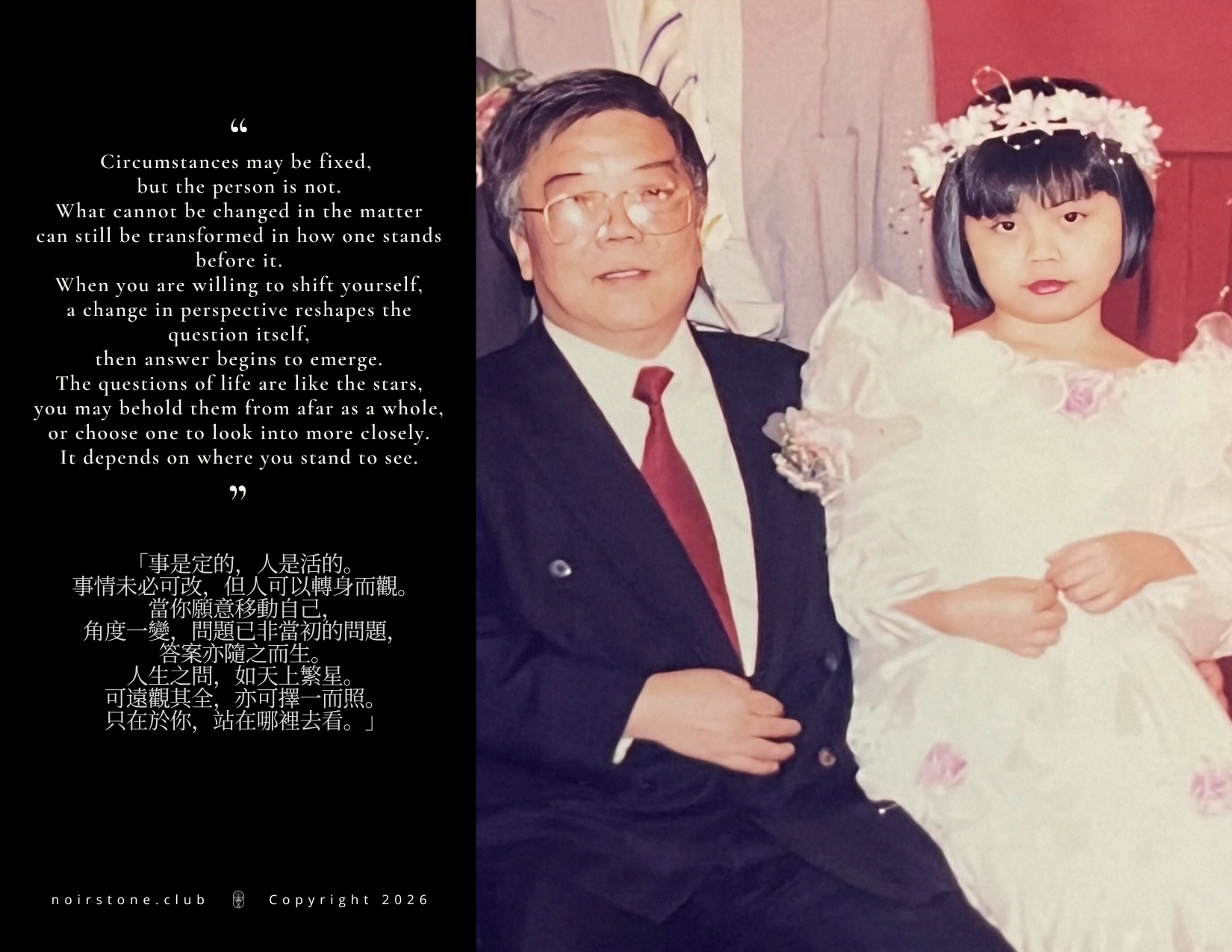
I was a child who carried “one hundred thousand whys.” I would often wait for my Ah-ba (means dad in Cantonese) to come home from work so that I could start offloading my questions. In truth, he was my uncle, but in my life, he was always like a father and my first mentor. He would listen and respond. Sadly, he fell ill when I was nine and passed away when I was eleven. From then on, many questions could only be directed inward:
我是一個總帶著「十萬個為甚麼」的孩子。我習慣等父親下班回家後,向他發問(其實他是我的伯父,但在我生命裡,他一直像父親一樣,也是我人生第一位導師)。他會聆聽,也會回應。可惜,在我九歲時他病發,十一歲那年離世。從此之後,有很多問題都只能向自己發問:
“Why do some people seem to move smoothly with the flow of life, while others feel as if they are constantly swimming against the current?”
“Why do some thrive in noise and crowds, while others need quiet and space to feel at ease?”
And “why do some minds move in clear, linear paths, while others think more like constellations—connected, expansive, and non-linear?”
「為甚麼有些人的生命似乎順勢而行,而另一些人卻總像在逆流之中?」
「為甚麼有些人在喧鬧與人群之中如魚得水,而另一些人卻需要安靜與空間才能自在?」
「為甚麼有些人的思考像直線般清晰,而另一些人的思維卻更像星空般充滿連結與跳躍?」
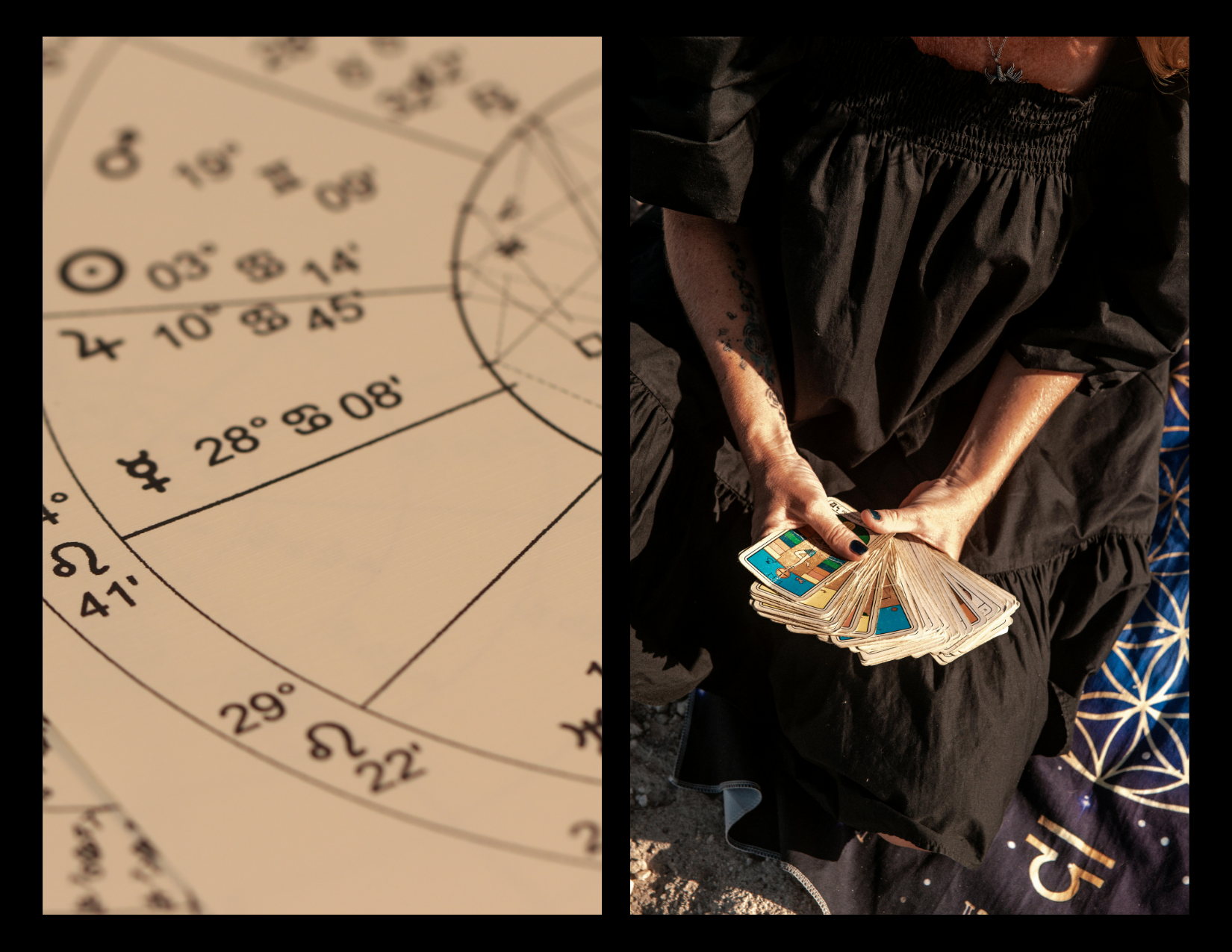
Later, I began searching for understanding in different places. My grandmother spoke of the worldview of Indonesians; I often checked out personality tests, Egyptian culture, and tarot in bookstores; self learned Western and Indian astrology; listened about Buddhism teachings from cousin-in-law, joined church teachings from missionaries; and listened to some radio programs about psychology.
後來,我開始在不同地方尋找理解何為人生。外婆談她們印尼人的世界觀; 書店裡的心理測驗、埃及文化、塔羅; 自學西洋與印度占星; 聽嫂嫂分享佛學及聽傳教士在教會講道;以及多聽關於心理學的講解。
Gradually, I began to notice something: different cultures seemed to be responding to the same question — the relationship between human beings and the universe. They simply used different languages. Within the Chinese context, this language has a name: destiny studies (命理).
慢慢地,我開始意識到一件事:不同文化、不同領域,似乎都在回應同一個問題 —— 「人,與宇宙之間的關係」。只是,它們使用不同的語言。在中國的脈絡裡,這種語言,有一個名字:命理。
Today, many people see destiny studies as a form of fortune-telling, prediction, or even a tool for profit. But after spending time with it, I realized it is more like a language — a way to understand one’s personality, physical constitution, relationships, and how one’s life timing interacts with the universe. For the ancients, it was closer to a general study of observing the relationship between nature and life. They understood that life is not static. They observed the seasons, the tides, and the movement of stars. And so, they observed humans in the same way.
今天,人們常把命理理解為一種占卜、預測未來或用來賺錢的技術。但當我接觸了一段時間之後才發現,它其實更像一種富有對自身性格、體質、人際關係及生命時間線理解力,同時與宇宙互動的語言。對古人而言,命理更接近一門觀察自然與的通識之學。他們理解生命並不是靜止的。 他們看見四季, 看見潮汐, 看見星辰的運行。於是,他們也這樣看人。
Destiny (命) is like a starting point—the life structure one carries at birth, comparable to DNA.
Fortune (運) is the flow of changing conditions over time, more like RNA—expressed and regulated through interaction with the environment.
命,像一個起點,是出生時所承受的生命格局,可以比喻為 DNA。
運,像是隨時間流動而變化的氣運,更像 RNA 在外在環境影響下的表現與調節,是一種趨勢。
In this sense, destiny studies resemble a manual of life.
命理像是一份生命的說明書。
Interestingly, this understanding of rhythm is not limited to the ancient world.
有趣的是,這種對節律的理解,並不只存在於古代。
In The Hitchhiker’s Guide to the Galaxy, the “answer to life, the universe, and everything” is calculated as 42. The answer appears absurd, yet it gently points to something: perhaps the question has never been only about the answer.
在《The Hitchhiker’s Guide to the Galaxy》中, 「生命、宇宙與一切的答案」被計算為 42。這個答案本身,看似荒謬。但它輕輕地提醒了一件事:也許問題,從來不只是答案本身。
In modern science, certain phenomena appear random, yet probability reveals patterns within uncertainty. This quietly echoes an Eastern perspective.
在現代科學中,某些事情,看似隨機, 概率描述卻是不確定之中的規律。這與東方的某種理解方向悄悄相遇。
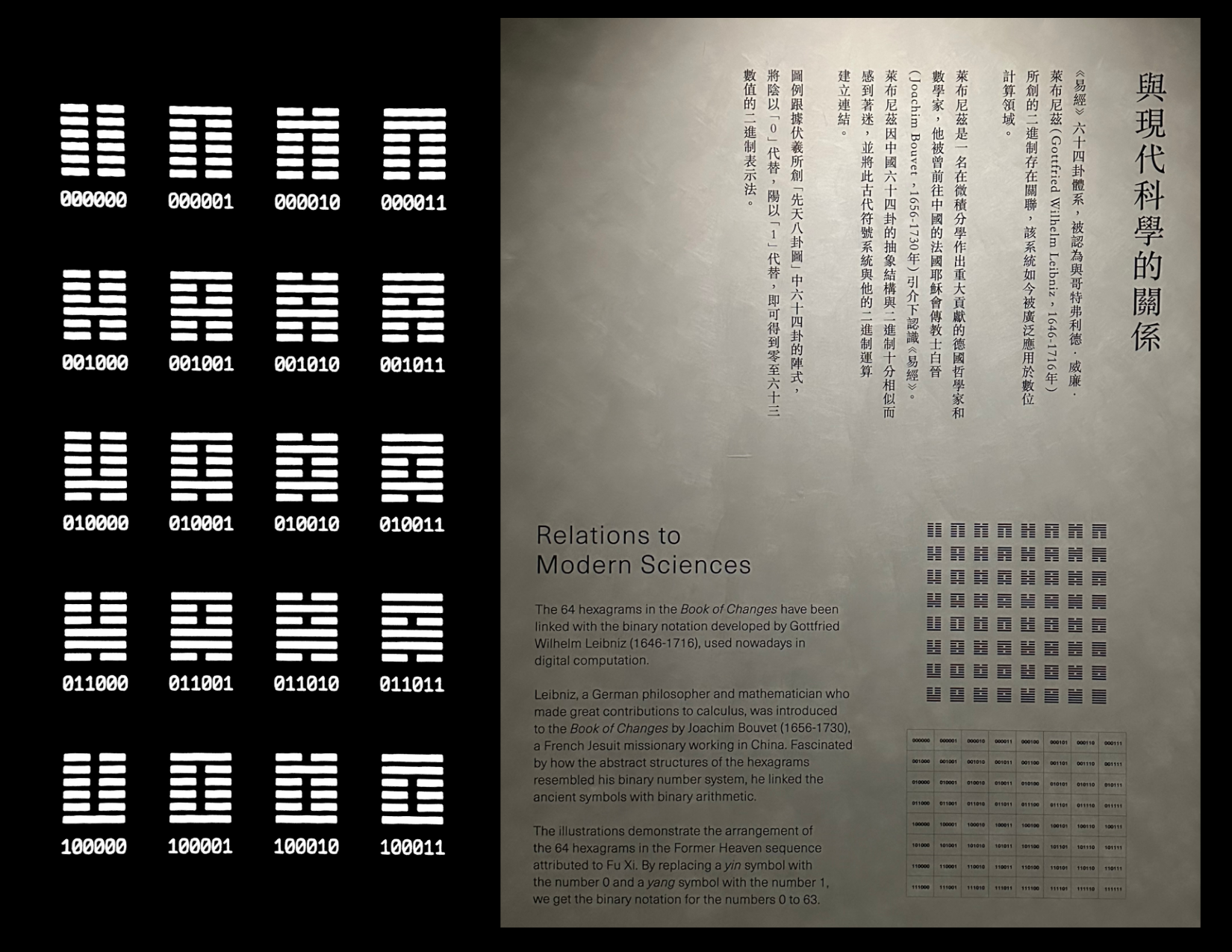
Long before many destiny systems emerged, the I Ching already existed. It does not rush to tell the future; rather, it allows one to see the present state.
在許多命理系統出現之前,《易經》已經存在。它不急著告訴人未來會怎樣, 而是讓人看見:此刻,正處於怎樣的狀態。
I once attended an I Ching exhibition at Tai Kwun in Hong Kong. It did not feel like a book to be “explained,” but a structure to be “observed” and “emerged”. There was an activity where visitors could draw their own hexagram. At that moment, no one else was there so I could have taken one immediately. Yet for some reason I paused, allowed two others to go first, and then took mine. The hexagram I received responded precisely to my state at that time.
我曾在位於香港大館觀嘗過一個關於《易經》的展覽。 那並不像一部需要被「解釋」的書,更像是一種可以被「觀看」及「感受」的結構。當時有一個環節,是讓人領取屬於自己的卦象。那一刻現場其實沒有人,我大可以直接去取。但不知為甚麼我停了一下,最後選擇先讓另外兩位參觀者領取,然後才輪到自己。結果,我拿到了一張剛好回應我當時狀態的卦象。
The next day, I returned with my husband and children. This time, there was a long queue. When it was their turn, the hexagrams they received once again corresponded precisely to what they needed in that moment. In that instant, a simple thought arose within me: if a computer program can generate patterns within what appears to be “random,” then within a crowd, at which position would a person need to stand in order to receive the hexagram that is meant for them? And if so, are we also living within some vast, unseen system which the earth is a giant computer?
第二天,我和先生帶著孩子再去。那一天,現場排起了長龍。他們排了一會兒,輪到他們時,拿到的卦象同樣精準地對應了他們當下的需要。那一刻,我心裡浮現一個很簡單的念頭——如果說電腦程式可以在「隨機」之中生成某種規律,那麼在人群之中,一個人需要排到第幾位,才會剛好拿到那一個屬於自己的卦象?那我們也只是活於形像是一個地球的超大電腦內?
In I-Ching, the sixty-four hexagrams are formed by yin and yang — opening and closing, movement and stillness.
在易經中,六十四卦,由陰與陽組成。 一開一合,一動一靜。
In modern language, it resembles an early encoding system. But what it truly points to is change — growth, transformation, peak, decline — the rhythms of life we experience daily. What appears random may be an order we have yet to fully understand.
如果用今天的語言去看,它甚至接近一種最早的編碼系統。⁴ 但它真正指向的,不是數字,而是變化。生長、轉化、極盛、回落 —— 是生命每天都在經歷的節奏、看似隨機亦是某種我們尚未完全理解的秩序。
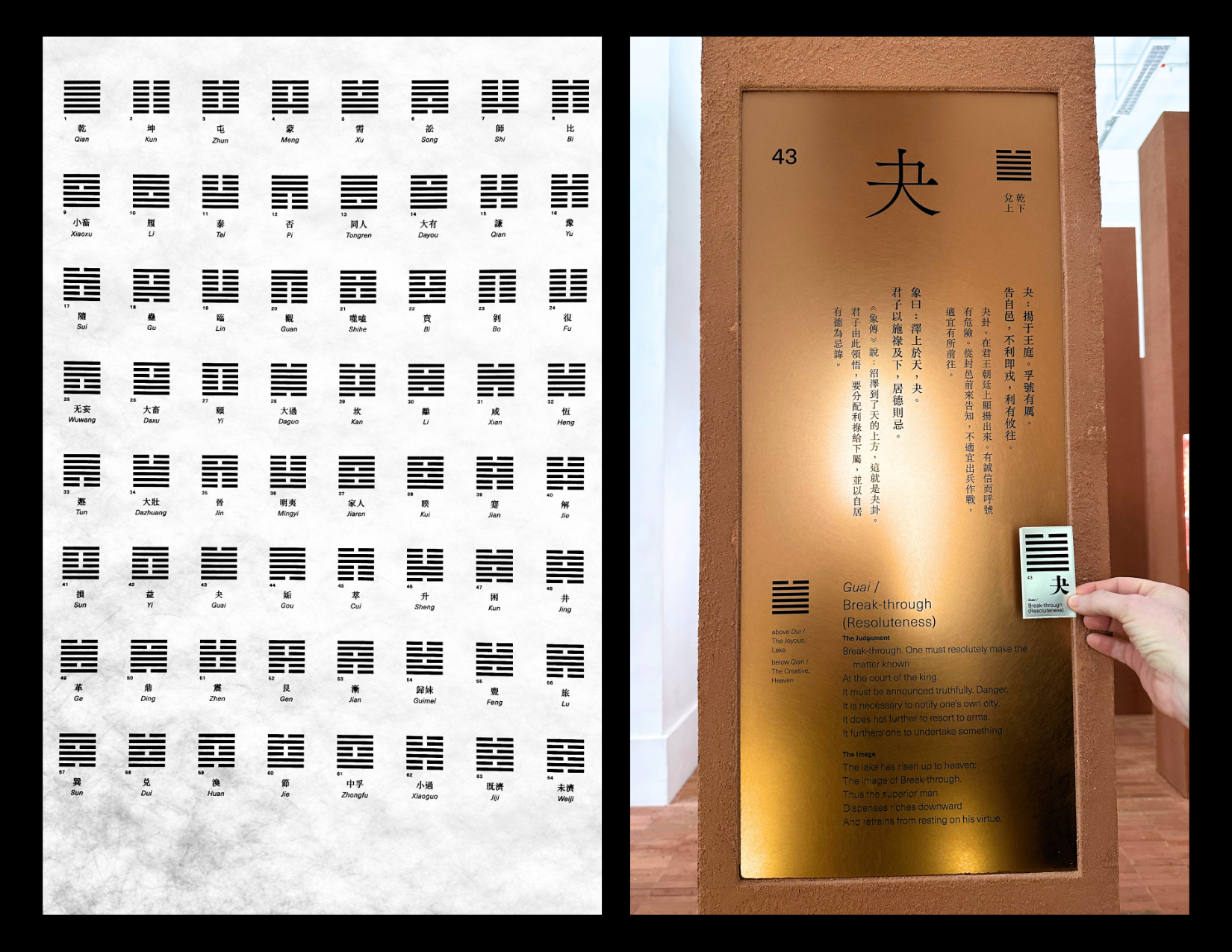
Within the cosmology of the I Ching, time is not merely linear. Each moment carries distinct qualities and energies. Just as seasons influence growth, the moment of birth is seen as aligning with specific cosmic rhythms. Thus, ancient people carefully observed the sky and time—solar terms, hours, directions.
在易經的結構及傳統宇宙觀裡,時間並不只是線性的流逝。每一個時刻,都被認為帶著不同的氣象與能量。正如春夏秋冬影響萬物生長,人出生的時刻,也被視為與某種特定的天地節律相接。因此,古人非常重視觀察天空與時間的變化——節氣、時辰、方位。
Imperial courts established official astronomers to observe celestial movements, create calendars, and record seasonal changes. In a sense, they were both astronomers and early climate scientists. These observations shaped how people understood cosmic order.
歷代朝廷設有專門的天文官,負責觀測星象、制定曆法與記錄節氣。某程度上,他們既是古代的天文學家,也像今日的氣象與曆法研究者。這些觀測影響人們對天地秩序的理解。
Many destiny systems are built upon this foundation. The Heavenly Stems and Earthly Branches, forming the sixty-cycle system, integrate astronomical rhythms with cyclical time. Unlike Western astrology, Chinese systems also incorporate the Five Elements—wood, fire, earth, metal, and water. Thus, destiny studies were never detached from nature. They are a language attempting to understand the relationship between humans and cosmic rhythms.
許多命理系統,其實正是建立在這套天文與曆法觀測之上。例如天干地支所構成的六十甲子,本身就是一套結合天文節律與時間循環的系統。與西方占星不同的是,中國占星同時結合了五行生剋的思想,試圖理解人與宇宙節律之間關係。
Before destiny studies were brought into the imperial court, many of their underlying theories were in fact developed by scholars. During the Tang and Song dynasties, literati often studied astronomy, calendrical systems, and destiny as part of their cultural refinement, much like the arts of music, chess, calligraphy, and painting. In the eyes of the emperor, however, this knowledge held significance at both political and state levels. By the late Song and into the Ming dynasty, the state gradually imposed restrictions on the private practice of astrology. As a result, parts of this knowledge among the public began to evolve into different systems of destiny studies.
在命理學被帶入宮廷之前,許多相關的理論其實由讀書人發展而來。唐宋時期,士人閒暇之餘常研究天文、曆法與命理,就像琴棋書畫一般,是文化修養的一部分。在皇帝眼中,這些知識卻具有政治與國家層面的重要性。到了宋末與明代,官方逐漸限制民間占星的使用。於是部分知識在民間開始轉化、逐漸演變出不同的命理系統。

Within this tradition, Seven Luminaries and Four Residuals was once known as a “royal study”. It precisely maps human life trajectories to the actual movements of celestial bodies.
在中國傳統命理的長河中,七政四餘曾被稱為「皇家絕學」。它是一套極為精密的星命系統,直接將人的生命軌跡與天體實際運行的度數相對應。
Scholars generally agree that it was not a purely indigenous creation, but rather a product of cross-cultural exchange during the Tang and Song dynasties. With the eastward transmission of Esoteric Buddhism in the Tang period, India’s Navagraha calendrical system and its astrological knowledge were introduced into China. Chinese scholars integrated these with local frameworks—such as the Twenty-Eight Lunar Mansions, the twelve Earthly Branch palatial divisions, and the philosophy of the Five Elements—forming a system that combined precise astronomical calculation with philosophical insight. Because calculating the movements and degrees of celestial bodies required advanced knowledge of astronomy and mathematics, this body of knowledge was largely held within the Imperial Astronomical Bureau and among the scholar-official class.
學界普遍認為,七政四餘並非完全本土研發,而是唐宋時期中外文化交流的產物。唐代隨著密教東傳,印度的《九執曆》與占星學進入中國。中國學者將其與本土的二十八星宿、十二地支宮位以及五行思想結合,形成一套兼具天文計算與哲學思維的星命體系。由於計算星體行度需要高度的天文與數學基礎,這門學問多掌握在欽天監與士大夫階層之中。
The “Seven Luminaries” refer to:
七政指的是七個實際天體:
Sun, Moon, Mercury, Venus, Mars, Jupiter, Saturn.
日、月、金、木、水、火、土。
The “Four Residuals” are symbolic points:
而四餘則是象徵性的天文點位:
Rahu, Ketu, Ziqi, Yuebo
羅睺、計都、紫炁與月孛
Rahu and Ketu originate from Indian astrology. In astronomical terms, they correspond to the points where the Moon’s orbit intersects with the ecliptic— the lunar nodes. Ziqi and Yuebo, on the other hand, are associated with special lunar positions, such as the Moon’s perigee. Although these “stars” do not have physical form and function as metaphoric constructs, within the symbolic system they represent latent shifts, unexpected developments, and forces of causality.
羅睺與計都源自印度占星中的 Rahu 與 Ketu,實際上是月亮軌道與黃道的交點。
紫炁與月孛則與月亮近地點等特殊天文位置相關。雖然這些「星」沒有實體,即是 Metaphor/象徵系統,它們代表潛藏的變化、意外與因果力量。

When discussing Seven Luminaries and Four Residuals, one important lineage is often mentioned—Guolao Xingzong. The text is traditionally attributed to Zhang Guolao, one of the Eight Immortals of the Tang dynasty. However, modern scholarship generally holds that the versions we have today were largely compiled by Ming dynasty scholars. The name “Guolao” serves more as a symbolic reference to its Daoist roots and sense of antiquity.
談到七政四餘,往往會提到一個重要派系 ——《果老星宗》。此書傳說由唐代八仙之一張果老所著,但現代學界普遍認為現存版本多為明代學者整理而成。「果老」之名,更多是一種象徵其道家淵源與古老傳承。
The text details complex computational methods, from establishing the Life Palace to arranging the eleven luminaries, and includes numerous case studies alongside interpretations of stellar configurations. In this sense, it is not only a manual for destiny analysis, but also a guide to the applied use of ancient astronomy and calendrical science.
書中詳述從立命宮到排十一曜的複雜推算方法,並收錄大量案例與星格解析。某程度上,它既是推命之書,也是一部古代天文曆法應用的指南。
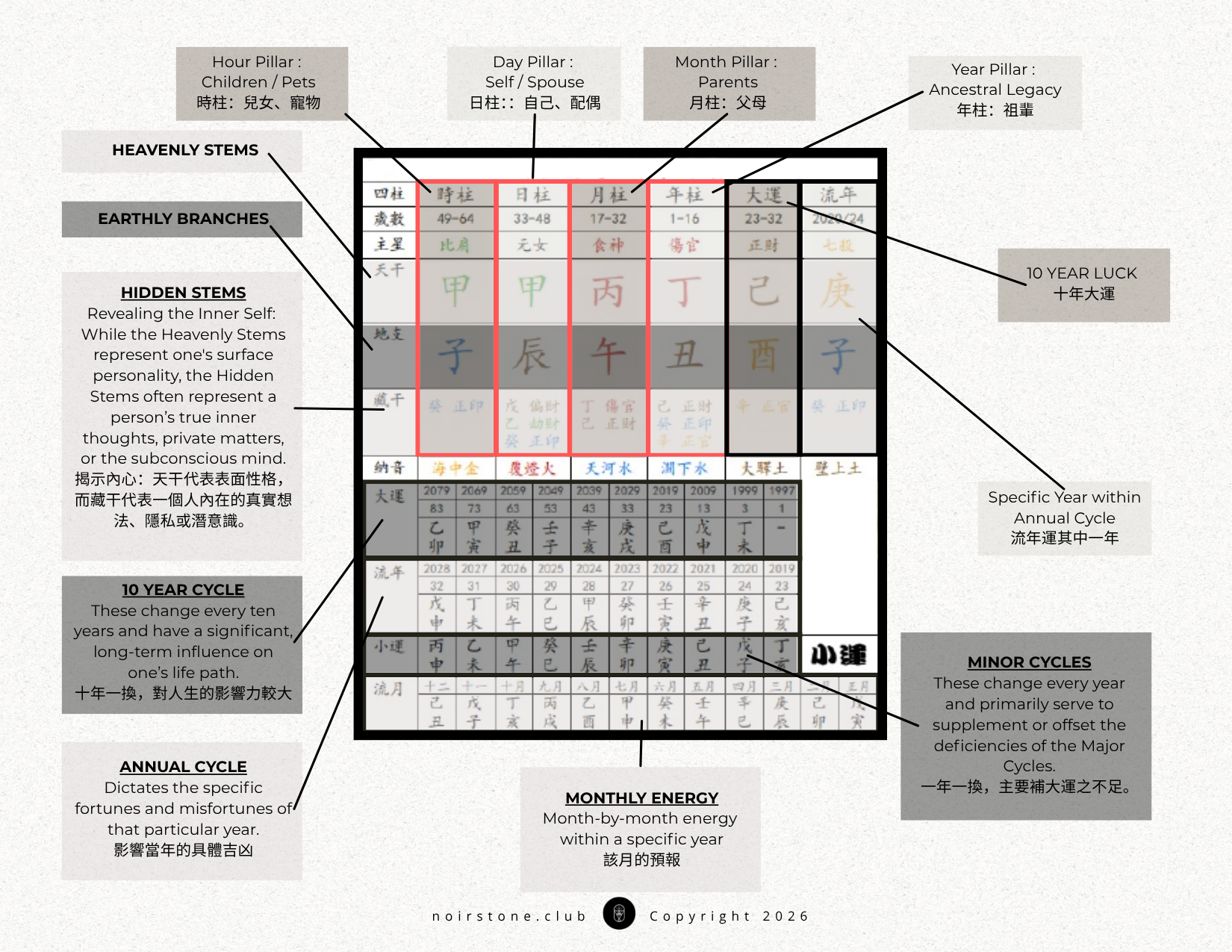
Within Chinese destiny studies, one of the most widely transmitted systems is Zi Ping Bazi or known as Four Pillars. It is generally traced back to Li Xuzhong, a destiny scholar of the Tang dynasty, who analyzed a person’s life through three pillars—year, month, and day of birth. As this method was considered limited in accuracy, later introduced additional frameworks, such as shen sha (auxiliary symbolic stars) and na yin (elemental correspondences), to refine interpretation.
在中國命理之中,最廣為流傳的系統之一是子平八字。一般認為,此法最早可追溯到唐代命理家李虛中。他以出生的年、月、日三柱來分析命格。由於準確度低,其後加了很多不同神煞及納音來扶助準確度。到了宋代,徐子平整理並加入「時柱」增加準確度,形成四柱八字的完整架構。因此,後世將這套方法稱為「子平法」。
At the core of Bazi lies a central concept: the Day Master.
在八字之中,有一個核心概念:日主。
The Day Master is the Heavenly Stem of the day of birth, representing the “self” within the chart. All other elements in the natal structure are understood in relation to it. These relationships are primarily interpreted through the dynamics of the Five Elements:
日主是出生日的天干,代表命局中的「我」。命盤中的其他元素,都是圍繞日主來理解其關係。這些關係主要透過五行的變化來解讀:
The interaction of these elements forms the energetic climate of a person’s life.
五行的互動,構成了一個人的生命氣象。
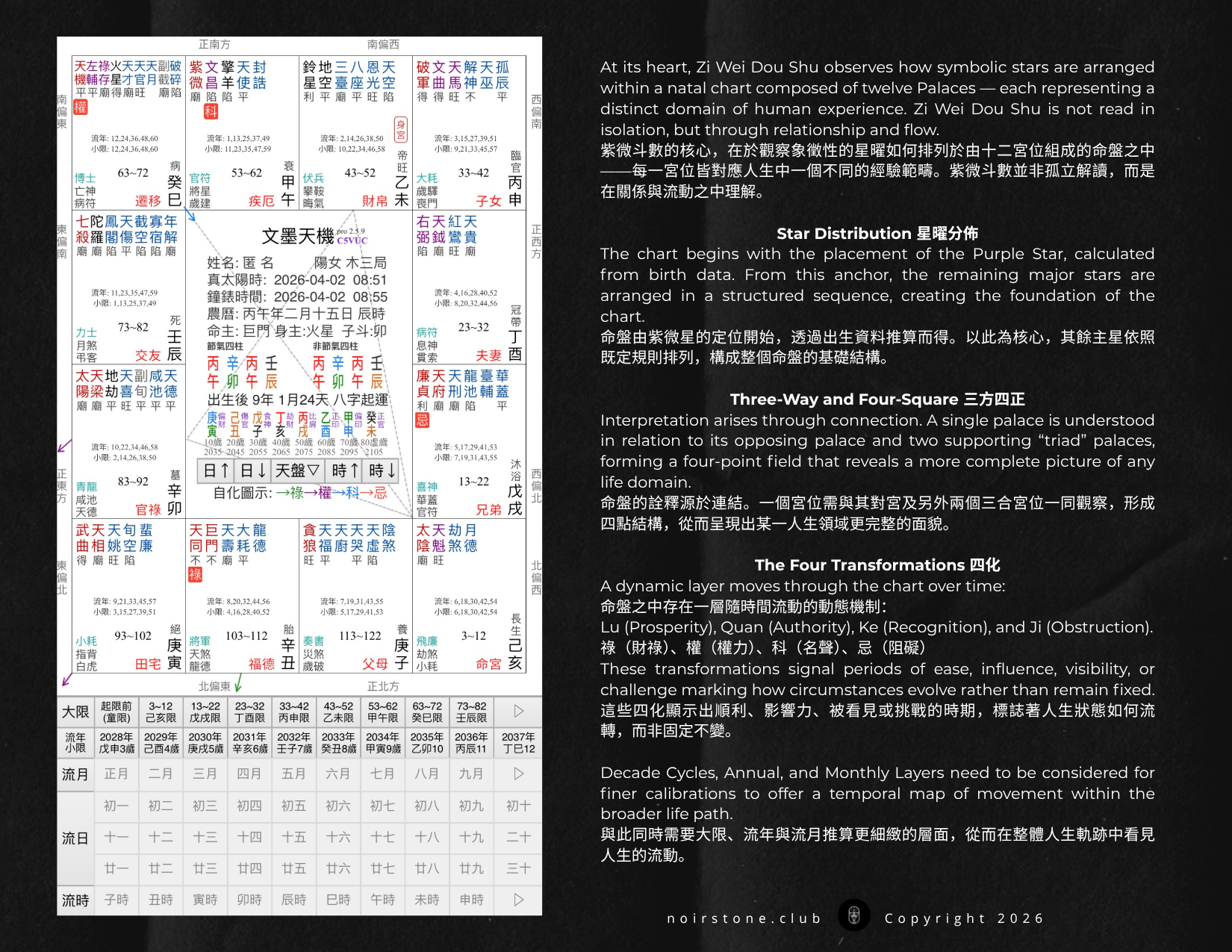
Beyond Bazi, another major system within Chinese destiny studies is Zi Wei Dou Shu or known as Imperial / Purple Astrology. Some consider it a later evolution of Seven Luminaries and Four Residuals as its 2.0 version, as there is a long-standing account that a court astronomer once carried imperial astrological knowledge out of the palace during a time of upheaval. In gratitude to the family who sheltered him, he transmitted this knowledge to them, which was later adapted into what became known as Imperial / Purple Astrology. While this narrative remains part of its cultural memory, the system itself differs in structure and method, though it continues to be widely studied and respected.
除了八字之外,另一套重要系統是紫微斗數。很多人認為紫微斗數是七政四餘2.0,因為相傳它就是當年一位欽天監趁皇宮被攻打時,帶宮中用的占星學逃走至民間。他為報答收留他的家人,他教了這家人這占星,亦改做紫微斗數。這跟七政四餘有不同,但也有不少學者追棒。
In Imperial / Purple Astrology, the chart is organized into twelve palaces, such as the Life Palace, Spouse Palace, Wealth Palace, Career Palace, Health Palace, and Virtue Palace. Various stars are distributed across these palaces, forming a symbolic map of one’s life structure. These stars are not physical celestial bodies, but are calculated through calendrical systems—symbolic constructs, or what may be understood as metaphoric stars.
整個命盤被劃分為十二宮位,例如命宮、夫妻宮、財帛宮、官祿宮、疾厄宮、福德宮等。不同星曜分佈在各宮位之中,形成一幅象徵人生結構的圖像。這些星曜並非實際天體,而是透過曆法推算出來的象徵性星曜,即是虛星。
At the center of this system is the most significant star: Zi Wei (Purple Star)
其中最重要的一顆是:紫微星
Within its symbolic language, Zi Wei is referred to as the “Emperor Star,” representing the central axis of the chart. Through the interplay between stars and palaces, Zi Wei Dou Shu portrays the overall configuration of a person’s life.
在象徵語言中,它被稱為帝星,代表命盤的中心。透過星曜與宮位的組合,紫微斗數描繪出一個人的生命格局。

Within the Bazi system, the number of possible chart combinations is theoretically around 518,400. If further refined, the number becomes even greater. The calculation is as follows:
60 (sexagenary year cycle) × 12 (months) × 60 (days) × 12 (hours) = 518,400. If we also take into account the different directional flows of fortune cycles between males and females, the variations in actual interpretation can reach 1,036,800. Yet the world’s population far exceeds this number, and so overlaps are inevitable.
在八字之中,理論上可推算的命盤組合約為518,400種。計算方式為:60 (花甲子年) × 12 (月) × 60 (日) × 12 (時) = 518,400。若考慮男女大運走向不同,實際論命時的變化可達1,036,800種。但世界的人數會遠遠超過這個數字,於是,自然會出現重疊。
There have also been cases where two individuals born at the exact same time go on to live entirely different lives. Even births in adjacent delivery rooms may diverge due to subtle differences in environment. Twins may appear to share the same chart, yet slight variations in timing can place them in different hour pillars.
也曾有案例顯示,兩個在同一時間出生的嬰兒,人生走向卻完全不同。甚至只是相鄰的產房, 因微微差別的環境而改變。雙胞胎的命盤,看似相同, 但時間的細微差異,也可能跨越不同時辰。
At a deeper level, the differences arise from one’s upbringing and environment, how one is understood, and whether one is allowed to become their true self. In this sense, what appears “the same” exists only within structure—never within life itself.
更深一層的差異,來自於—— 成長的家庭及環境、 被如何理解、 或是否容許成為真正自己。於是,「相同」從來只存在於結構之中,而不在生命本身。

A Daoist and Bazi Master, Master Choi, once remarked in class:
“Many of the interpretive statements passed down from ancient times are no longer suited to the present. Modern students of destiny studies must remain flexible in their thinking. Rather than clinging to classical phrases, one should apply logical analysis and adapt interpretations to the conditions of contemporary life. Only then can judgments be accurate, reasonable, and truly grounded.”
道教師傳與八字老師蔡進源曾在班上提到:「古代流傳下來的許多論斷語句,但已不合時宜。現代命理研究者必須保持思考的靈活,不應拘泥於古籍章句,而應以邏輯分析去推論,並切合現代人的生活模式,方可做到論斷準確、合情、合理。」
This echoes a principle often emphasized in the study of Chinese medicine. Dr. Arthur Lo reminded his students: “A physician must not cling rigidly to fixed prescriptions when treating a living person.” Once the principles are understood, they must still be applied according to time, place, and individual.
這其實與學習中醫時,勞惠光博士提醒後輩「醫者不能執死方醫活人」的原理一樣。理解原理之後,還需要因時、地、人而用。
With the rise of modern computing, calculations that once required prolonged observation and manual effort can now be completed within moments. This has allowed systems such as Guolao Xingzong, Qizheng Siyu, and Zi Wei Dou Shu to re-emerge as accessible tools for exploring the relationship between the self and the cosmos.
隨著電腦計算的普及,過去需要長時間觀測與計算才能完成的排盤,如今已可以迅速完成。這也讓《果老星宗》、七政四餘與紫微斗數等古老智慧,再次成為現代人探索自身與宇宙關係的工具。
Yet it is unfortunate that some practitioners reduce destiny studies to result-oriented claims, using outcomes as a selling point while overlooking its deeper cultural and philosophical foundations. These voices often carry further, and in doing so, contribute to widespread misunderstanding of the discipline.
可惜的是,部分江湖術士只取result oriented效果論的說法作為賣點,忽略了命理原本的文化與哲學背景。這樣的聲音往往更為響亮,反而讓這門學問被外界誤解。
Lyricist and Zi Wei Dou Shu author Yip Hon Leung once wrote in Chronicles of the Stars:
“The ancient Chinese were not without a sense of humor. They saw clearly through unrealistic expectations and superficial appearances, and knew how to describe and satirize them. In the Book of Wei, Volume 66, Biography of Li Chong, it is written: ‘Though the Imperial Academy bears the name of having officials of learning, it lacks the substance of teaching—how is this any different from rabbits that spin silk or swallows that produce wheat, or from the Southern Dipper and Northern Ladle?’” In essence, it criticizes things that exist only in name but not in reality.
知名填詞人及紫微斗數書作者葉漢良在「星象本紀」中提到:「中國古人不是沒有幽默感的,對於不切實際的期望、虛有其表的現象,看得一清二楚,並且知道怎樣去描述,怎樣去諷刺。《魏書.卷六十六.李崇傳》記載:『今國子雖有學官之名,而無教授之實,何異兔絲燕麥,南箕北斗哉!』意思是說,虛無飄渺、不切實際的東西,便好像會吐絲的兔子、會生產麥子的燕子一樣不存在….」。用現代話來說,就是批評「徒有其名、有名無實」。
To truly apply destiny studies, one must first understand its underlying principles—with care and sincerity.
所以活用也要用心了解當中原理。
As I continued studying destiny with the intention of understanding life, I began to see more tangible patterns such as inclinations of personality, modes of interaction, directions of focus, and how a person expresses themselves within particular moments in time. At the same time, I came to realize that what we call “different lives” is often not a matter of right or wrong, but a difference in rhythm.
當我以理解生命為目的繼續研讀命理時,我開始逐漸看見一些更具體的東西,例如是性格的傾向、互動的模式、專注的方向,以及一個人如何在某時間之中展現自己。同時,也開始意識到:所謂「不同的人生」,很多時候並不是對錯之分,而是節奏的差異。
When one begins to understand that each person carries their own life structure, a different way of relating naturally emerges. Not a rush to judge, but a willingness to first understand.
當一個人明白,每個人都有各自的生命結構,自然會生出另一種方式對應,不是急於評價,而是先嘗試理解。
Some people are especially sensitive to sound and emotion;
some possess an extraordinary depth of focus;
others do not think in linear ways at all, but rather in networks or constellations of connection.
有些人對聲音與情緒特別敏感;
有些人擁有極深的專注力;
也有些人的思考方式,本來就不是線性,而更接近網絡或星狀結構。
In modern language, these tendencies are often categorized and defined through psychiatry or psychology. Yet within earlier systems, they were simply seen as different expressions of temperament. In many cases, they are also the very qualities that support individuals in becoming exceptional artists, screenwriters, creators, healers, scientists, and software engineers.
在現代語言中,這些會被精神科或心理學歸類、被定義。但在更早的系統裡,它們只是不同的「氣質表現」。其實也是促使他們成為出色的藝術家、編劇、創作人、心靈治療師、科學家、軟件工程師等必備的優勢。
The I Ching and the principle of yin and yang have always pointed to one thing: within change, there is no single standard to be pursued. When the ancients said, “Destiny is given by Heaven; fortune is shaped by oneself,” it was not an invitation to passive acceptance, but to recognize what is given while also responding with awareness and adjustment.
《易經》與陰陽的觀念,始終在提醒一件事:變化之中,本來就不追求單一標準。而古人所說「命由天定,運由己生」,並不是要人只去「認命」,而是接受既定安排同時作出適當調整。
A person may not be able to choose the conditions they are born into, but how they understand and work with those conditions is directly related to cultivation. This is why, when one begins to understand oneself, many aspects once seen as “problems” gradually find new placement.
一個人也許無法選擇出生時所承載的條件,但如何理解、如何運用,則與修養直接相關。這也是為甚麼當一個人開始理解自己,很多原本被視為「問題」的部分會慢慢被重新定位。
With understanding, a person gains the space to adjust—not merely to correct themselves. The role of destiny studies here is not to provide conclusions, but to offer a framework through which one can observe oneself. It allows one to see their rhythms, tendencies, and limitations, and also how to work with them. And this act of “seeing” is, in itself, the beginning of cultivation.
理解之後,人才有空間去調整,而不是單純地修正自己。命理在這裡的作用,並不是提供結論,而是提供一個觀看自己的框架。讓人看見自己的節奏、傾向與限制,也看見可以如何與之合作。而這種「看見」,本身就是修養的起點。
In reality, many people turn to destiny studies in an attempt to make better arrangements for the future. For example, choosing a specific time for a child to be born, in the hope of securing more favorable conditions from the very beginning. This impulse is understandable. Yet if we think of “destiny” as a seed, then the quality of its outcome has never depended on the seed alone. More crucial is the soil that holds it.
在現實之中,很多人會透過命理,嘗試為未來作出更好的安排。例如為孩子選擇出生的時間,希望在一開始,就取得一個更理想的條件。這種做法本身,可以理解。但如果把「命」比喻為一顆種子,那麼條件的優劣,從來不只在種子本身。更關鍵的,是承載它的土壤。
Is there enough space for it to grow?
Is there a stable environment to support its development?
Is there someone who understands its natural rhythm, rather than trying to reshape it by force?
是否有足夠的空間讓它生長,
是否有穩定的環境讓它發展,
是否有人理解它本來的節奏,而不是強行改變它。
Otherwise, even a seed considered “good” may not grow into what it was meant to become. And this returns us to a more fundamental question: before seeking answers, has one truly understood their own question and their intention behind it?
否則,即使是一顆被視為「好的種子」,也未必能夠長成它原本的樣子。這也回到一個更根本的問題:人在尋找答案之前,是否已經清楚自己的問題與意圖?

Perhaps, I have simply been finding my way into the right place, slowly. From being the child whom friends would turn to in kindergarten to share their thoughts, to now, I still find myself—across different spaces—“randomly” becoming the one who listens, the one people open up to. They speak of things they may not otherwise have the chance to say.
或許,我只是慢慢用對了自己的位置。從在幼稚園常被朋友找來談心事開始,到現在,我仍然會在不同的場合裡,「隨機地」成為那個傾聽、被傾訴的對象。人們會打開自己,說出一些未必有機會說出口的事情。
In the past, I did not fully understand this. It was only later that I began to realize that certain traits are a direction. When they are seen and accepted, they gradually find a way to be held—and to be lived.
過去,我並不特別理解這件事。直到後來,我才開始意識到有些特質,本身就是一種方向。當它被看見、被接受,也就慢慢有了可以承載它及運用它的方式。
Noirstone emerged from within this process.
Noirstone,便是在這樣的過程中出現。
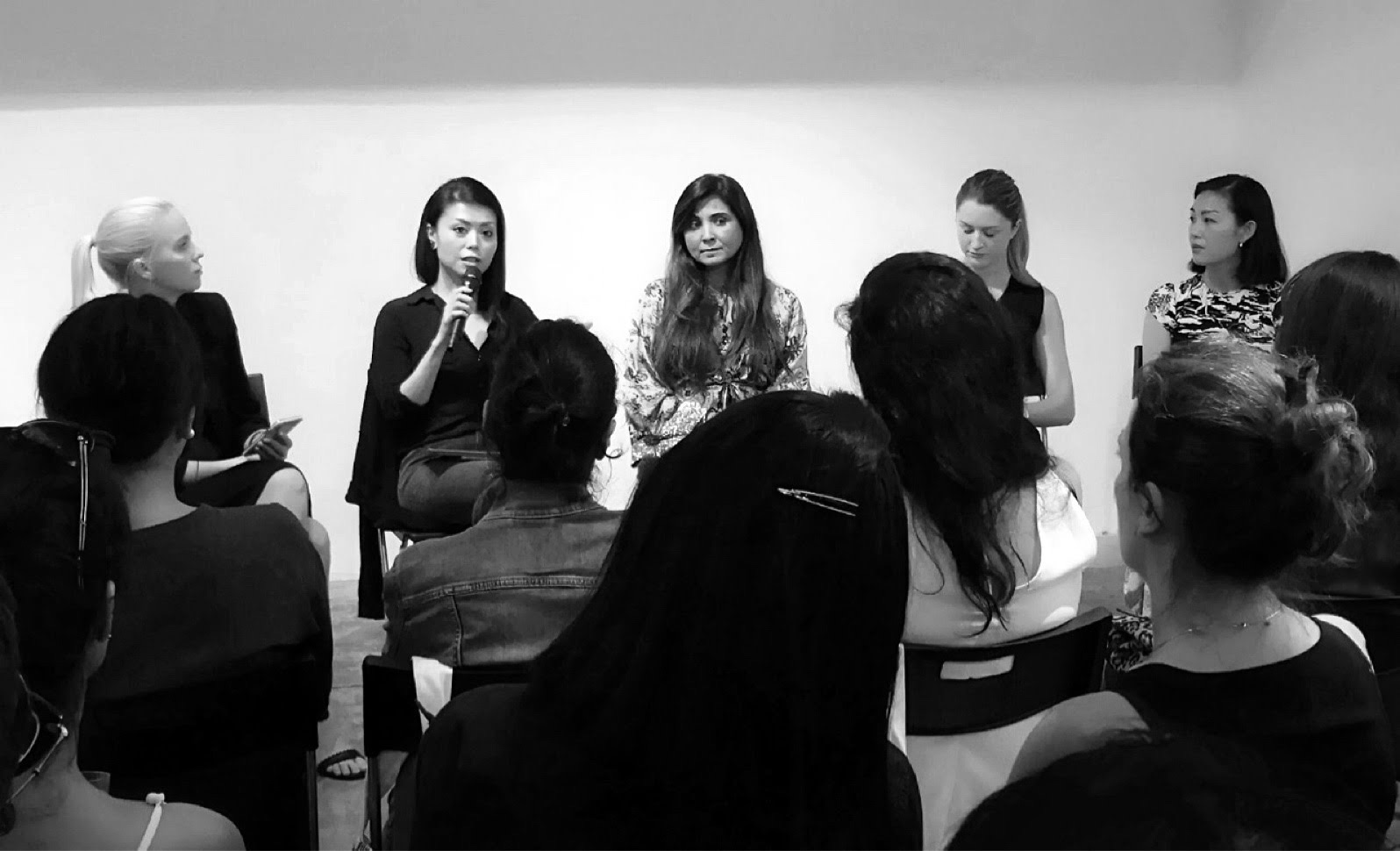
It was never meant to provide answers, but to gather what has been understood and heard along the way, and shape it into a language that can be shared. And so, people arrive with their own questions, not leaving because they have found answers, but because they are gently moved to see their questions differently.
它並不是為了給出答案,而是把一路走來所理解的、聆聽到的,整理成一種可以被分享的語言。於是,人們帶著各自的問題而來,不是因為找到了答案才離開,而是被啟發開始用另一種方式看待自己的問題。
So if one were to ask what destiny ultimately brings ?
所以,如果說命理最後帶來的是甚麼?
Perhaps it is not prediction, nor control.
或許不是預知,也不是掌控。
But a subtle shift:
而是一種很細微的轉變:
From trying to find answers, to beginning to understand the question.
從試圖找到答案,到開始理解問題。
From rushing to change outcomes, to slowly seeing one’s place.
從急於改變結果,到慢慢看見自己的位置。
Perhaps destiny is no longer only about what is arranged, but about how one continues to move within it.
And perhaps — it has always been a form of hope.
命運,也許不再只是關於安排,而是關於天生我材必有用,人在其中,仍然可以如何前行。
它可能本是希望。
Photos : Noirstone | Nicole Lui | Unsplash 五玄土 ORIENTO | Unsplash insung yoon| Unsplash Anderson Rian| Unsplash Lennon Cheng | Unsplash 泽新 李
Disclaimer: This publishing is made for informational and educational purposes only. It is not intended to be medical and life advice, nor an exhaustive list of specific treatment protocols. The approach and perspective is only based upon the content contributor’s knowledge, research, or clinical experience. The content creators, authors, editors, reviewers, contributors, and publishers cannot be held responsible for the accuracy or continued accuracy of the information or for any consequences in the form of liability, loss, injury, or damage incurred as a result of the use and application of any of the information, either directly or indirectly. Each plan must be individually tailored with the guidance and clinical judgment of your medical or healthcare practitioner or related advisor.
免責聲明:內容僅供資訊及教育用途,並非醫療或專業建議,亦非特定治療方案。本文所提供的方法與觀點,僅基於內容撰稿者的知識、研究或臨床經驗。內容創作者、作者、編輯、審閱者、貢獻者及出版方,對於資訊的準確性或持續準確性,或因使用及應用該等資訊而直接或間接導致的任何責任、損失、傷害或損害,概不承擔任何後果責任。每一項療法或計劃必須在您的醫療或健康護理、或相關專業人員的指導及臨床判斷下,作個別化的調整而定。